
PHYSICS - Forces 07 PRACTICE
OPENING QUESTION: Here ya are in an elevator. What forces are acting upon you as:
 |
1) You stand there at rest? 2) You accelerate upwards? 3) You accelerate downwards? |
Does your mass change?
Does the acceleration due to gravity change?
What the heck *does* change?
═══════════════════════════
FORMULAE OBJECTUS:
Newton's Second: F = ma
Newton's Second (weight): w = mg
Newton's First/Second analytics: ∑Fx = max ;∑Fy = may
LEARNING TARGET: I will be able to complete elevator problems during today's class.
I will review hanger problems today.
I will review ramp problems today.
WORK O' THE DAY:

STUDY GUIDE SECTION IS HERE:
MR W SAYS:

Please use it!
═══════════════════════════
Let's say you have a mass of 65.13 kg. What force must the elevator exert on you to accelerate you upwards at 2.13 m/s/s?
Also, if you are standing on a bathroom scale during your ride in the elevator, what weight will it show?
ANSWER (with Annotations!):
List initial conditions: m = 65.13 kg Ag = -9.81 m/s/s Ael = 2.13 m/s/s |
Remember your mass NEVER changes. Acceleration due to gravity is ALWAYS negative The elevator will accelerate you upwards at 2.13 m/s/s by exerting an unbalanced force on YOU |
Step #1: Sum the forces:
|
There ain't no motion in x, let alone acceleration in x, so we ignore the forces in x cause there ain't none |
∑ says to sum the forces, so let's list them first: W + Fel = may
|
Remember, your weight pushes down on the elevator and the elevator pushes up on you! |
Substitute mg for W mg + Fel = may
|
We keep in mind that you are experiencing an unbalanced force supplied by the elevator that is accelerating you upwards |
Isolate Fel Fel = may - mg
|
Note: Mass (m) is the same m for both (it's YOU!) |
Factor out mass: Fel = m(ay - g)
|
|
Substitute: Fel = 65.13 kg(2.13 m/s/s - (-9.81 m/s/s)
|
Notice that gravity ends up being a minus minus! |
Solve: Fel = 777.65 N Fel = 778 N s.f.
|
Let's try a slightly different take on this problem
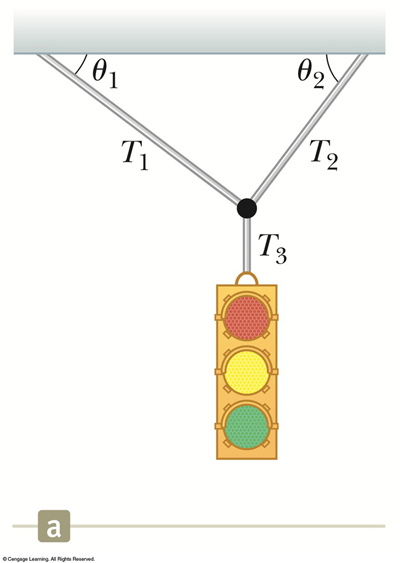 |
If θ2 is 53o, and T2 is 97.50 N, what is the horizontal component of force T2x → (97.50N)(cos53o) = 58.7 N = 59N s.f. What condition(s) MUST be present if T1x = T2x? →The light must NOT be accelerating horizontally If the weight of the signal light is greater than T1y + T2y, what MUST occur? → The light would accelerate downwards What is the value of the vertical component of force exerted by T1? →T1 sinθ1 If this signal was hanging on Mars, the supporting ropes would need to support less mass, more mass or the same mass? → mass never changes, so the ropes would need to support the SAME mass Would the ropes need to be stronger, could they weaker or should they be the same on Mars? |
Practice ramp problem:
A 2.13 kg block made of oak slides down a ramp (also made of oak)
The ramp has an angle of 43.7 degrees to the horizontal.
The coefficient of friction for Oak vs Oak is .620
Will the block slide down the ramp?
Justify your response mathematically
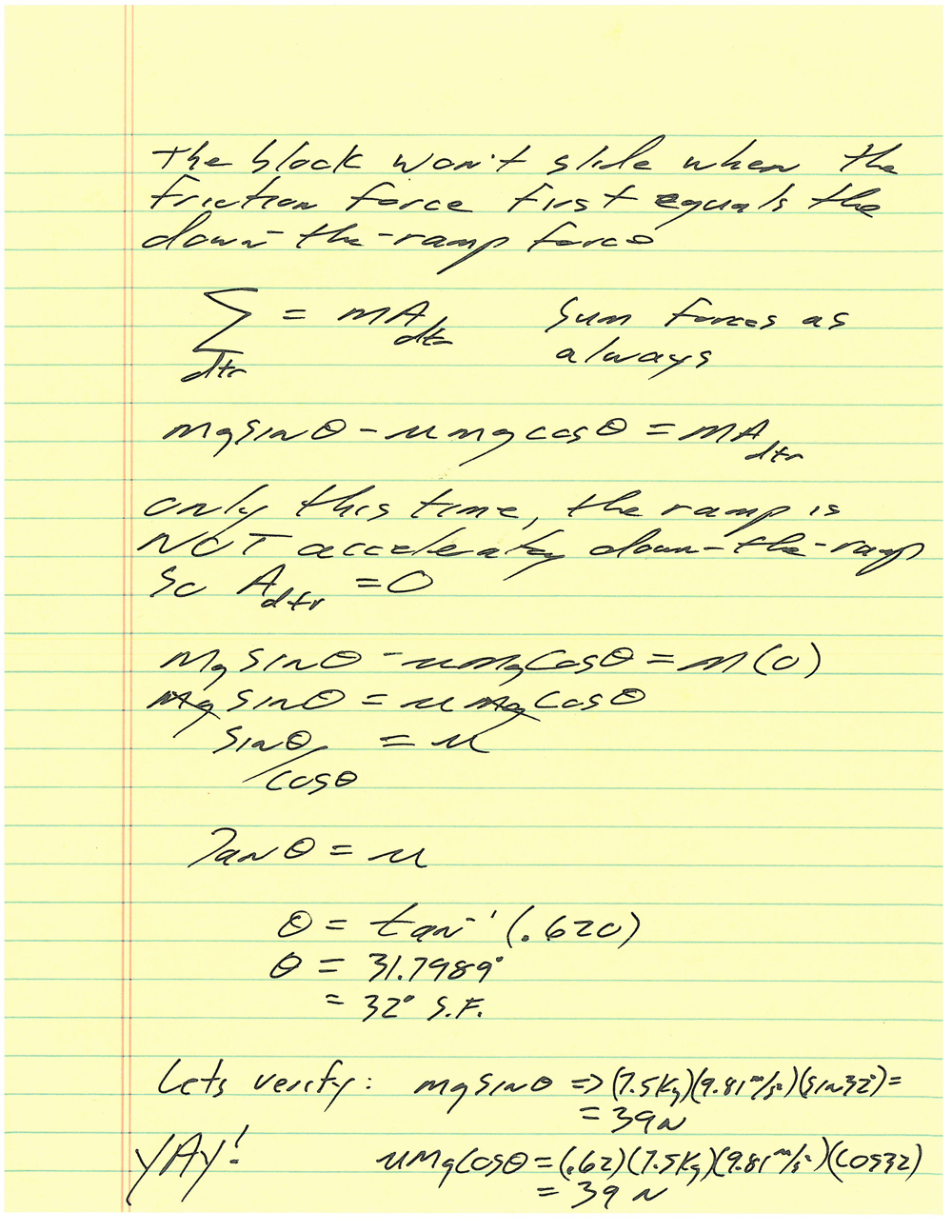
NOW: What is the largest angle possible where the block would NOT slide?
═══════════════════════════
MORE ELEVATOR PRACTICE
═══════════════════════════
How fast would an elevator have to accelerate you such that you weight increased by .635 times?
═══════════════════════════
ANSWER (No PEEKING!)